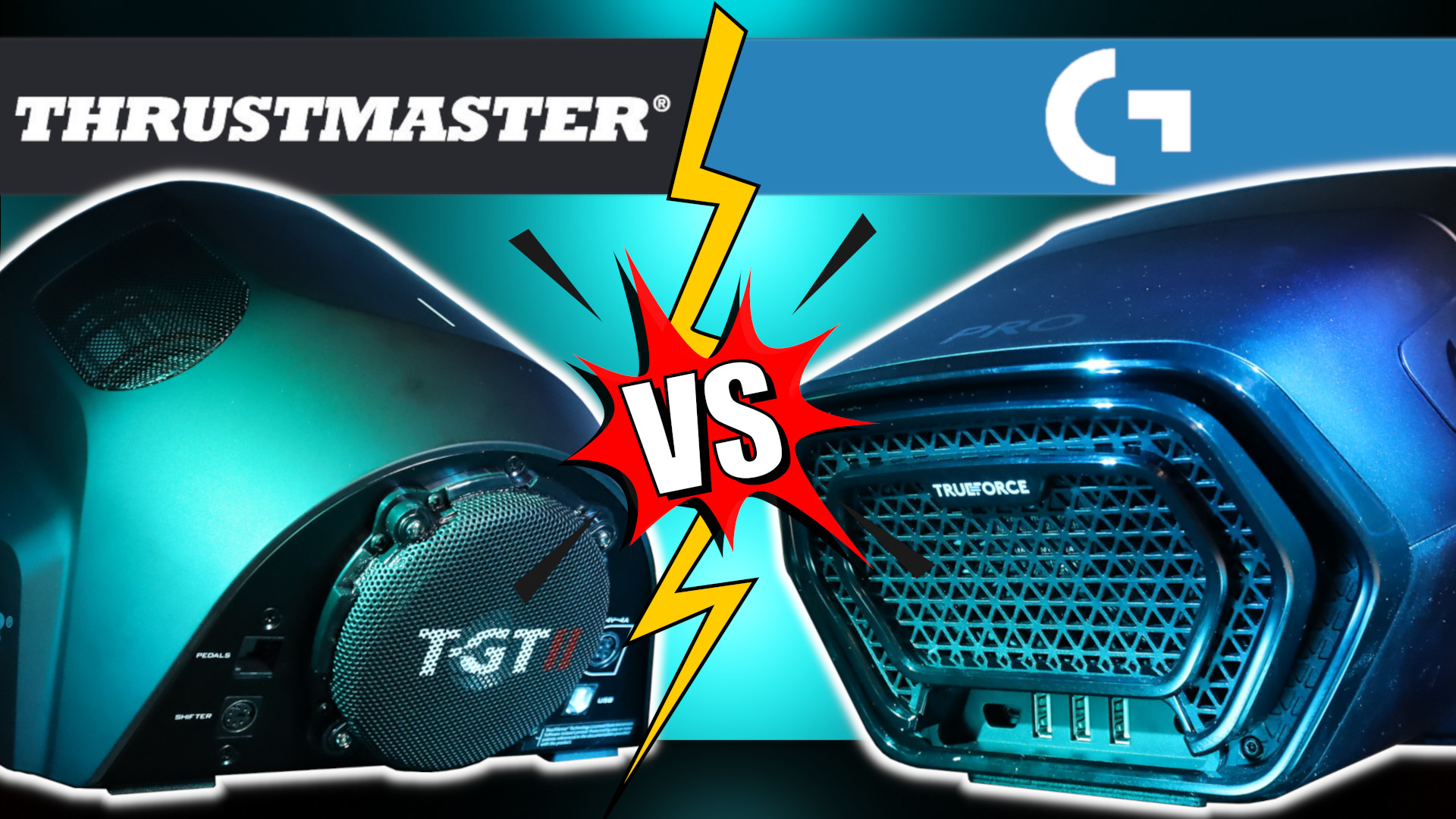
Thrustmaster T-DFB and Logitech TrueForce — The Battle of the Haptics
Today we’ll be taking a close look at two innovative haptic systems that aim to make your sim racing experience more immersive — Thrustmaster’s T-DFB and Logitech’s TrueForce.
Both technologies attempt to go beyond standard force feedback by adding extra layers of tactile detail.
But how they do this, and how they feel, are very different stories.
🕹️ Introduction and Concept
Thrustmaster T-DFB
- Released in 2017 with the T-GT wheelbase, and later included in the T-GT II.
- Designed to add extra sensations — like engine revs, shifting jolts, suspension bumps, and track surface texture — to the base’s existing force feedback.
- The haptics are generated by an internal bass shaker built into the wheelbase itself.
Logitech TrueForce
- Introduced in 2020 with the Logitech G923, and later featured in the Logitech G Pro.
- Shares a similar goal: to bring real-time game telemetry into tactile feedback.
- Instead of using a shaker, TrueForce relies on an advanced algorithm that makes use of the motor’s high-frequency response to produce vibrations and micro-details.
🎯 In short:
T-DFB = physical shaker inside the base.
TrueForce = software-driven haptics through the motor.
⚙️ Force Feedback and Feel
Without T-DFB activated, the T-GT already delivers solid detail — you can feel kerbs, surface texture, and slip, though it can feel slightly flat.
That’s where T-DFB comes in.
When enabled (via the Gran Turismo settings menu), it instantly adds life to the experience:
- Gearshifts feel like jolts through the wheel and pedals.
- Road texture gains a subtle vibration layer.
- The car feels alive.
However, tuning options are limited — only a single intensity level slider in Gran Turismo.
Set it too high and you lose road detail; too low and it feels dull.
Some fine-tuning would’ve been welcome here.
On the other hand, the Logitech TrueForce system allows for much more customization.
You can:
- Adjust TrueForce intensity directly on the wheelbase.
- Fine-tune effects through game menus or even config files (like in iRacing).
When correctly balanced, TrueForce offers:
- Crisp rev feedback.
- Noticeable gearshift jolts.
- Delicate road vibrations that complement traditional FFB instead of overpowering it.
In comparison:
- 🌀 T-DFB feels a bit more raw and mechanical.
- ⚡ TrueForce feels more precise and refined.
🧠 Configuration and Customization
| Feature | T-DFB | TrueForce |
|---|---|---|
| Adjustment Location | In-game (Gran Turismo only) | On wheelbase + in-game menus |
| Fine-Tuning | ❌ Limited | ✅ Extensive |
| Firmware Impact | Minor | Noticeable improvements over time |
| Game Support | GT Sport, GT7 | Wide range (GT7, iRacing, ACC, BeamNG…) |
The customization flexibility clearly goes to Logitech here.
Being able to tweak settings directly on the wheelbase or in different games gives TrueForce a big advantage.
🧩 Compatibility
This is where the gap really opens up.
- T-DFB:
Exclusive to the Gran Turismo series (GT Sport, GT7, and likely GT8).
That’s it. The limited compatibility is likely due to TouchSense licensing (used to power the bass shaker). - TrueForce:
Supported in a growing list of games, including:- Gran Turismo 7
- iRacing
- Assetto Corsa Competizione
- BeamNG
- and several others
✅ Winner: Logitech TrueForce — by a large margin.
🔬 Driving Impressions
When driving both systems back-to-back:
- The T-GT (with T-DFB) feels more intense — the transducer gives a visceral, mechanical punch with each shift and rumble.
- The G Pro (with TrueForce) feels cleaner — the detail is more nuanced, especially in engine vibrations and subtle bumps.
If tuned too high, TrueForce can drown out normal FFB, but at medium settings (~30%), it perfectly balances realism and immersion.
When I first tried TrueForce in the G923, it felt harsh and overdone.
In the G Pro, it’s evolved — more polished, dynamic, and natural.
🔋 Technology and the Future
The evolution of haptics in sim racing has only just begun.
Fanatec has recently announced FullForce, their take on this concept — though as of now, no games fully support it yet.
When they do (with iRacing and Gran Turismo on the roadmap), it’ll be fascinating to see how it compares.
As direct-drive wheelbases become more similar in torque and smoothness, haptic technologies like TrueForce and T-DFB are what will truly differentiate brands.
These systems add layers of realism and emotion that pure torque can’t replicate.
🧾 Verdict
| Category | 🏁 Winner |
|---|---|
| Technology Concept | Draw |
| Feel & Precision | TrueForce |
| Raw Immersion | T-DFB |
| Customization | TrueForce |
| Compatibility | TrueForce |
| Ease of Use | TrueForce |
| Intensity & Punch | T-DFB |
While the T-DFB still feels fantastic — especially for Gran Turismo fans — its limited compatibility and lack of configuration options make it hard to recommend broadly.
TrueForce, by contrast, is:
- More refined
- Widely supported
- And highly tunable
It adds that extra layer of immersion that makes every drive more engaging — without overpowering the base’s natural feedback.
The T-DFB might have started the movement, but TrueForce perfected it.
And with Fanatec’s FullForce entering the race soon, we’re clearly heading into an era where haptics are just as important as force feedback.