
Thrustmaster T818 vs CAMMUS C12
Today we’re putting two direct drive wheelbases head-to-head: the Thrustmaster T818 and the CAMMUS C12.
Both aim to deliver premium force feedback and realistic driving sensations — but one gives you far more for your money. Let’s dive in.
💰 Price & Availability
The first major difference is price.
- 💸 CAMMUS C12: around $550 / €507
- 💸 Thrustmaster T818: around €650
However, the T818 only includes the wheelbase — no steering wheel.
Add a decent wheel, and you’re quickly at €850 or more.
That alone already puts the C12 ahead in value.
🧩 Design & Form Factor
📏 Size & Shape
The CAMMUS C12 is a compact unit — only 6.5 cm deep — while the T818 is a bulky rectangular block.
The smaller size of the C12 makes it easier to position your monitor closer, while the T818 can obstruct your view, especially in tighter setups.
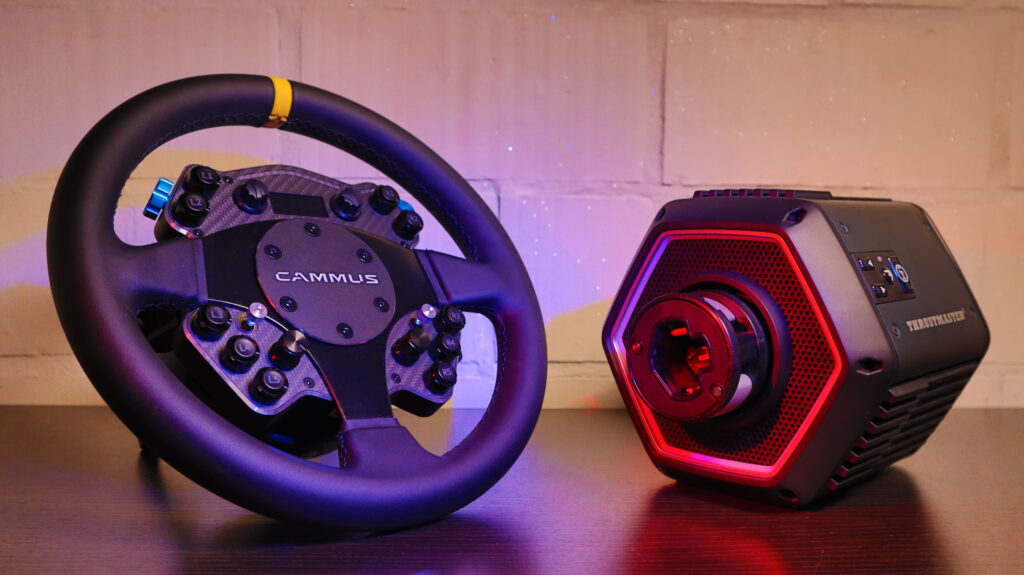
Older rigs might even struggle to fit the T818 because of its unusual mounting hole spacing.
The C12, on the other hand, fits perfectly on most rigs, including my SimXpro without issue.
🎨 Customization
The T818 supports optional colored side plates, allowing some personalization.
The C12, due to its integrated design, doesn’t — though it looks sleek right out of the box.
💡 LEDs & Lighting
Both brands clearly understand the importance of visual flair:
- The T818 sports an illuminated octagonal LED ring.
- The C12 features programmable light-up buttons on its steering wheel.
Both look great — but the C12’s buttons add a touch of futuristic cool.
🏗️ Build Quality
This is where the differences really start to show.
🧱 Thrustmaster T818
- Mostly plastic construction
- A few metal parts like the quick-release latch and side plates
- Feels solid but not premium at this price point
🪨 CAMMUS C12
- All-metal construction, with only two plastic buttons and some carbon fiber
- Feels far more premium and durable
Even the C12’s steering wheel and button box feel significantly higher-end than any Thrustmaster wheel — even compared to the €400 SF1000.
For build quality, the C12 is the clear winner.
⚙️ Technology & Performance
⚡ Torque & Motor Type
- C12: 12 Nm (external rotor)
- T818: 10 Nm (internal rotor)
The C12 has a slight torque advantage, and its external rotor design provides a smoother, more open feel.
🔄 Quick Release
The T818 offers a metal quick-release system, while the C12 does not.
If you frequently swap wheels, this might matter — otherwise, not a dealbreaker.
🛣️ Driving Impressions
🪵 Road Feel
Both deliver excellent feedback, but they do so differently:
- The T818 feels sharper, translating bumps and small road imperfections very clearly.
- The C12 feels softer and more refined, with more realistic surface transitions — especially on gravel or grass.
The kerb feedback is slightly better on the C12, offering just the right level of vibration without being harsh.
🕹️ BeamNG Experience
In BeamNG.drive, the C12 shines:
- Smooth, balanced, and incredibly immersive
- Perfect return-to-center behavior
- No need to tweak endless settings
In contrast, the T818 required manual tuning in-game and through software to get to a satisfying setup — and even then, it never felt quite as natural.
💻 Software & Configuration
Here lies one of the biggest differentiators.
🧠 CAMMUS Software
The CAMMUS control software (v1.5.74) is a work in progress, but it’s already much more capable than Thrustmaster’s.
It offers:
- Clear presets
- Custom tuning options
- Easy updates and user-friendly controls
Out of the box, it just works.
🧩 Thrustmaster Software
The Thrustmaster Control Panel is still limited.
While a new beta version was recently released, it mostly improved the UI rather than functionality.
There’s hope — but for now, CAMMUS has the advantage in software usability.
Edit: Thrustmaster has released a new software panel which brings it almost on par with the CAMMUS software
🔌 Compatibility & Ecosystem
Both are PC-only at the moment.
🪛 Thrustmaster
- Wide ecosystem: pedals, shifters, handbrakes, multiple wheels
- One missing piece: no 30 cm leather steering wheel similar to the CAMMUS
🧠 CAMMUS
- Smaller ecosystem, but growing
- Offers pedals and alternative steering wheels
- Smart design choice: standard 70mm hole pattern on the button box, allowing aftermarket wheel compatibility
That’s a huge win for flexibility and modding potential.
🏁 Verdict: Which One Wins?
Both wheelbases are a joy to drive, but they target slightly different audiences.
🥇 Overall Winner: CAMMUS C12
For its price, build quality, software, and driving feel, the C12 is the clear winner of this comparison.
It delivers a premium, compact, and powerful experience that punches far above its price range.
🥈 Thrustmaster T818
Still an excellent base with top-notch force feedback detail and an established ecosystem — but feels overpriced and limited by its software.
✅ Choose the CAMMUS C12 if:
- You want value for money
- You appreciate metal build quality
- You prefer plug-and-play software
- You enjoy tinkering with different wheels
✅ Choose the Thrustmaster T818 if:
- You already own Thrustmaster wheels (like the SF1000)
- You need a quick-release system
- You’re invested in their ecosystem
🏁 Final Verdict
“The CAMMUS C12 delivers premium force feedback and build quality at nearly half the price of the T818. It’s the smarter buy for most sim racers.”
If you find my reviews helpful and you’re planning to buy something, using my affiliate link really helps support the channel — at no extra cost to you. Thank you!
Extra resources:
- 🎥Video
- 🛒Affiliate-link CAMMUS (Voucher Neosphinx for 5% off)
- 🛒Affiliate-link Thrustmaster (Use code SimTourist)


