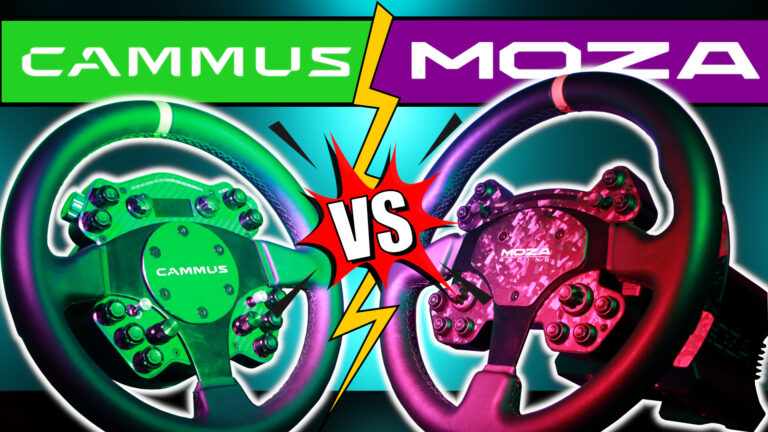
CAMMUS DDWB21 vs C12 — Go for power
Today, we’re diving deep into a head-to-head comparison between two wheelbases from the same stable — the CAMMUS DDWB21 and the CAMMUS C12.
At first glance, these two might seem similar, but when you dig deeper, their design philosophy and driving feel couldn’t be more different. Let’s find out which one takes the crown in this compact power duel.
💰 Price & Availability
Both the C12 and the DDWB21 are priced aggressively compared to the competition.
- C12: $549 (≈ 505 €)
- DDWB21: $609
Availability is roughly the same. CAMMUS has distribution hubs in several countries, and orders from China are possible too. For what you get, both wheelbases offer incredible value — though the C12 sneaks in a little cheaper.
🧱 Design & Build
Here’s where things start to differ. Both bases use aluminum housings with metallic accents, but that’s where the similarities end.

- The C12 uses an external rotor motor, making it much more compact and lightweight.
- The DDWB21, on the other hand, is heavier, bulkier, and features a sleek industrial design with retro switches and light-up buttons.
Mounting options also differ:
- DDWB21: can be attached via bottom mount or side extrusions.
- C12: uses four bolts and can also be fitted with an optional desk clamp — perfect for compact rigs.
🎮 Steering Wheels & Controls
The DDWB21 comes with the GT1 32 cm wheel, which is functional but simple.
The C12, however, includes a 30 cm integrated wheel and button box that feels more modern, premium, and feature-rich.
✨ Highlights of the C12:
- Programmable RGB button LEDs
- Rev-bar and digital display
- Solid metal shifters (though non-adjustable)
- And the true game-changer — a mouse-emulating joystick 🕹️, perfect for BeamNG or navigating menus without reaching for a mouse.
Everything about the C12 feels a step above in quality and practicality.
⚡ Performance & Force Feedback
Under the hood, both bases take very different approaches:
- DDWB21: Internal rotor motor with 15 Nm constant torque.
- C12: External rotor motor with 12 Nm torque, but capable of higher peak bursts.
Despite the lower specs, the C12 often feels stronger and more natural in use.
The DDWB21 delivers a raw, aggressive type of force feedback, while the C12 focuses on smoothness and realism.
🛣️ On track, the C12 provides:
- Softer, smoother road feel
- More natural weight transfer
- Better center return
- And a refined sensation of depth
The DDWB21, by contrast, feels grittier and more direct, especially on rough surfaces — which some may prefer for immersion.
🧩 Compatibility & Connectivity
Here’s a big difference:
- The DDWB21 includes seven RJ ports for accessories — great in theory, but those connectors can be fragile.
- The C12 simplifies everything with two USB-C ports instead — a more modern and durable solution.
Both bases are PC-only, configurable through CAMMUS software, which allows tuning for torque, damping, and button mapping. The C12’s software adds extra features like a constant force filter and customizable rev-bar lighting.
🧠 Driving Experience
When driving, both wheelbases feel alive but in different ways.
- The DDWB21 transmits stronger jolts and sharper road texture.
- The C12 delivers silky precision and a more cohesive driving feel.
For daily use or long sim sessions, the C12’s balance of strength and smoothness feels more natural. It’s particularly satisfying in games like BeamNG and Assetto Corsa Competizione, with a snappy center return and great detail through the corners.
🔧 Ecosystem & Expansion
Neither base has a huge ecosystem yet, but this is where CAMMUS could really grow.
- The DDWB21 supports multiple accessories through RJ ports.
- The C12 currently lacks cross-compatibility with the GTS wheel frame and has limited add-ons.
A H-pattern shifter, truck wheel, or additional button modules would make a huge difference. CAMMUS could take a cue from MOZA here, who expanded their lineup with a variety of unique steering options.
🏁 Verdict
The CAMMUS DDWB21 was a great proof of concept — powerful, bold, and affordable.
But the C12 represents everything CAMMUS has learned and refined since then.
It’s lighter, more compact, smoother, and feels more powerful despite the lower torque rating.
Build quality has improved across the board, and the extra customization and polish make the C12 a clear winner for most sim racers.
Unless you specifically need the DDWB21’s quick release or RJ accessory ports, the C12 is the smarter, sleeker, and more advanced choice.
The DDWB21 may have paved the road, but the C12 drives it better.
It’s the future-proof, refined evolution of what CAMMUS set out to build — compact, powerful, and smooth as butter.
If you value realism and modern design, the C12 wins this duel hands down.
If you find my reviews helpful and you’re planning to buy something, using my affiliate link really helps support the channel — at no extra cost to you. Thank you!
Extra resources:
- 🎥Video
- 🛒Affiliate-link (Voucher Neosphinx for 5% off)