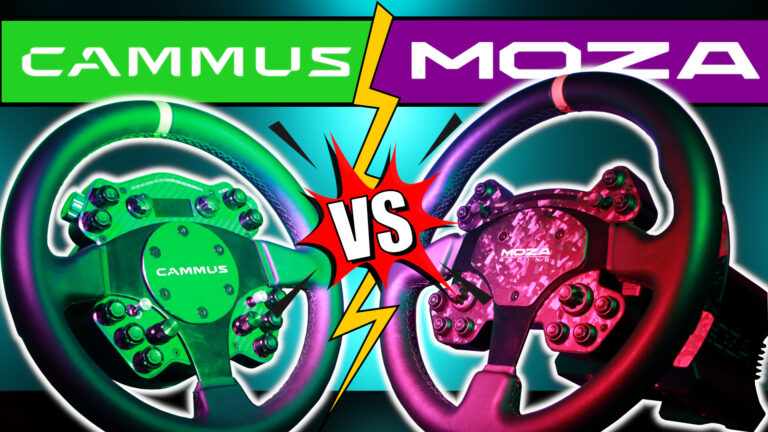
CAMMUS C5 vs MOZA R3 — The Battle of Budget Direct Drive Packages
Today we’re comparing two of the most affordable direct drive packages for PC — the CAMMUS C5 and the MOZA R3.
Both are available at €329 / $329, and both promise a full plug-and-play experience. Let’s see which one gives you the better value for your hard-earned cash.
🧰 What’s in the Box
Both packages include:
- A wheelbase
- A steering wheel
- Pedals
- And a desktop clamp
At first glance, both kits look similar — but the details tell a different story.
🧱 Desktop Clamp & Build
Both desktop clamps feature a triangular construction with two screws to secure your setup.
The CAMMUS clamp edges ahead here: it offers better inclination angles and a more refined design, complete with a printed logo and even a spot for the external cooling fan.
The MOZA R3 clamp, on the other hand, is simpler and more understated — but functional nonetheless.
🦶 Pedals: Size, Feel, and Options
Here’s where the first real difference appears.

The CAMMUS C5P pedals are significantly smaller than the MOZA SRP-Lite pedals.
Both use magnetic sensors to register input and come in a two-pedal setup, but the MOZA allows for an optional clutch pedal and wider spacing thanks to its larger baseplate.
| Feature | CAMMUS C5P | MOZA SRP-Lite |
|---|---|---|
| Pedal Size | Smaller | Larger |
| Sensor Type | Magnetic | Magnetic |
| Adjustable Spacing | ❌ | ✅ |
| Clutch Upgrade | ❌ | ✅ |
| Connection | RJ11 + USB | RJ11 (to R3) |
In feel, the MOZA pedals offer a clearer distinction between accelerator and brake, while the C5P pedals feel more uniform.
Both brands offer third-party load-cell upgrades (like from 3DRap) — a must for anyone seeking more realism.
🏎️ Wheelbase & Steering Wheel
The MOZA R3 is powered by a traditional direct drive motor delivering 3.9Nm of torque, while the CAMMUS C5 uses an external rotor motor capable of 5Nm, with peaks up to 7Nm.
Both connect via USB-B, but the R3 includes two extra peripheral ports, giving it an edge for future add-ons.
🕹️ Steering Wheel Comparison
| Feature | CAMMUS C5 | MOZA R3 |
|---|---|---|
| Size | 28cm D-shape | 28cm D-shape |
| Buttons | 16 + D-pad + 3 encoders | 18 + D-pad |
| Material | Faux leather | Hard plastic/rubber |
| Shifters | Small, quiet | Larger, clicky aluminum |
| Quick Release | ❌ | ✅ |
The C5 wheel feels thicker and more premium to the touch, but the MOZA shifters give a more satisfying mechanical click.

The rev-bar and retro speedometer on the C5 add a fun futuristic touch, but the quick release system of the R3 is the real game-changer — it opens the door to a world of wheel swaps and upgrades.
🧩 Driving Experience
In-game, both deliver an impressive experience for their price.
- MOZA R3 shines with road detail and subtle feedback.
- CAMMUS C5 wins in force feedback intensity, especially in fast corners or high-load situations.
You can feel the C5’s strength on high-speed turns, while the R3 impresses with fine texture and finesse on straights and curbs.
Both offer pleasant driving sensations, but the MOZA’s shifters feel more enjoyable in use, and the C5’s wheel grip feels superior even through gloves.
🧠 Software and Tuning
- MOZA Pit House is clean, polished, and intuitive — an example of great UX design.
- CAMMUS software feels slightly less refined but still offers all essential tuning parameters.
Both allow you to fine-tune gain, damping, road detail, and curvature, meaning you can get both systems dialed in for Assetto Corsa Competizione (ACC) or any sim of choice.
The main difference lies in aesthetics — MOZA’s software just looks more finished.
🔧 Upgradability and Ecosystem
Here, the MOZA ecosystem wins hands down.
It’s not just about sim-racing anymore — MOZA also offers trucking wheels, multi-functional stalks, and a growing range of peripherals that enrich the experience.
CAMMUS, by contrast, has a limited ecosystem right now.
You can, however, buy the C5 base standalone, without pedals or clamp — something MOZA doesn’t allow for the R3.
So if you want to start small and build your setup piece by piece, C5 offers more flexibility.
🧱 Build Quality and Reliability
Both wheelbases are solidly built, though some users have reported paddle durability issues on the C5. Replacing the paddles falls under warranty and will be replaced after logging a ticket.
CAMMUS seems to be more transparent about hardware issues than MOZA, which is worth noting.
Overall, neither has major structural flaws.
💶 Price & Value
At €329 / $329, both kits are excellent value.
The C5 offers more torque and optionality,
while the R3 brings refinement, ecosystem depth, and expandability.
You truly can’t go wrong with either.
🏁 Conclusion: Which Should You Buy?
If you want the most powerful and immersive feel out-of-the-box, go for the CAMMUS C5.
If you prefer a more polished ecosystem with better upgrade paths and accessories, the MOZA R3 is the smarter long-term investment.
Both deliver the best bang-for-buck direct drive experience on PC right now.
Whichever way you go, you’re entering the world of true force feedback — and that’s what matters most.
If you find my reviews helpful and you’re planning to buy something, using my affiliate link really helps support the channel — at no extra cost to you. Thank you!
Extra resources:
- 🎥Video
- 🛒Affiliate-link MOZA
- 🛒Affiliate-link CAMMUS (Voucher Neosphinx for 5% off)