
Turtle Beach VelocityOne Race Review — Built for Driving, Not Quite for Racing?
Today we’re diving into the VelocityOne Race from Turtle Beach — a direct drive racing wheelbase that generated plenty of buzz at launch. With a sleek design, integrated display, and console compatibility, it certainly looks impressive on paper. But how does it perform in practice? Let’s find out.
⚙️ Design & Build
The VelocityOne Race houses its K-Drive direct drive motor, capable of 7.2 Nm of torque, inside a dashboard-style matte-black casing. The illuminated window at the front reveals part of the drive unit — a nice touch — while a 12 cm color display dominates the front panel.
You’ll find:
- Four console buttons on the lower right
- Dual USB-C ports on either side for accessories
- Two power buttons and a headset jack on the right
- Additional USB-C ports and PSU input on the rear
It connects via USB-C to USB-A for both PC and Xbox.

While functional, the overall look is bulky and plasticky, lacking the premium aesthetic seen in competitors. Mounting options include three bolts or a hidden desktop clamp, and the metal quick-release feels reassuringly solid.
🕹️ Steering Wheel
The wheel measures 30 cm wide and 26 cm high, featuring a D-shape design. It combines perforated and smooth leather textures, faux-carbon spokes, and subtle stitching.
Controls include:
- 6 face buttons + 2 trigger buttons on top
- D-pad joystick with a rotary encoder on the left
- Rotary encoder with two buttons on the right
- Magnetic shifters, dual-clutch paddles, and hidden rear buttons

The backlighting and display integration are visually impressive, though the material quality and stitching feel a bit below par for the price point.
🎛️ Extra Button Box
One of the most distinctive features is the detachable button box.
It connects via USB-C and can be mounted on either side of the wheelbase.
You get:
- 1 capped safety switch
- 1 power button
- 1 kill switch for the K-Drive
- 3 rotary dials
- 4 standard buttons
- 4 three-position switches (excellent for truck and sim enthusiasts)

The carbon-fiber-look finish complements the wheelbase well, even if it feels slightly toy-like up close.
🦶 Pedals
The pedal set combines a plastic frame with aluminum pedal faces and heel plate.
- Throttle & clutch: adjustable spring stiffness
- Brake: 50 kg load-cell (no mechanical stiffness/travel adjustment)
- Connection: USB-C to USB-A (either directly to PC or via the wheelbase)
- Pedal faces: adjustable slightly in four directions
- Brake: can be moved outward a few centimeters

A clever touch — the clutch pedal can be folded flat, great for storage or non-clutch use.
🧱 Build Quality
Build quality is average across the board.
The plastic casing isn’t a deal-breaker, but the steering wheel feels hollow and overly light, with cheap-feeling stitching and soft clutch paddles.
The pedal base lacks rigidity compared to metal alternatives.
On the plus side, the buttons and shifters provide a satisfying click, and the quick-release mechanism feels secure.
💻 Software & Compatibility
Turtle Beach’s software suite is simple — maybe too simple.
You get only three adjustable force-feedback settings, far fewer than most competitors. LED configuration was unreliable during testing, and overall user experience felt unfinished.
Compatibility:
- PC & Xbox supported
- On Xbox, game telemetry support is limited
- On PC, many titles integrate directly through Turtle Beach software, or via SimHub for dashboard data
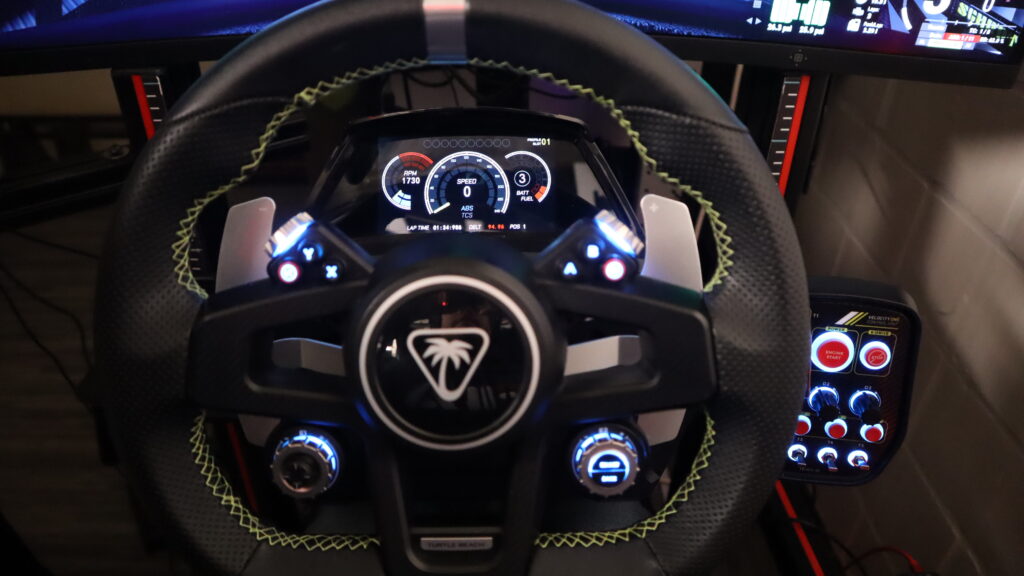
The 12 cm display is beautiful but underutilized when telemetry data isn’t supported.
🌀 Force Feedback Performance
The force feedback feels decent on straights — responsive and detailed over kerbs — but disappointingly flat in corners.
There’s no meaningful lateral force, resulting in a lack of connection to what the virtual car is doing mid-turn.
Power delivery is fine for its rating, but the detail and nuance expected from a 7.2 Nm direct drive aren’t fully there.
This is where the VelocityOne Race struggles against dedicated sim-racing gear.
🧤 In-Use Impressions
The trigger-style top buttons are excellent for quick look-around functions or secondary inputs.
Lighting, the large display, and the integrated button box all contribute to an immersive cockpit setup.
Unfortunately, the D-shaped wheel isn’t ideal for truck or car simulators requiring large rotations — a round wheel option would make a big difference.
Without gloves, the plastic feel of the rim becomes apparent, though the lightweight build can be less fatiguing during long sessions.
🚚 Perfect Match for BeamNG & Driving Simulators
While it underperforms in pure sim racing, the VelocityOne Race shines in driving simulators like BeamNG, Euro Truck Simulator, and American Truck Simulator.
The display doubles as a dashboard for speed and RPM, which is handy when your on-screen dash is out of sight.
The abundance of buttons makes it easy to map lights, wipers, or auxiliary controls, turning this wheel into a fantastic immersion tool for more casual or exploration-based driving sims.
Force feedback in these games feels balanced, with enough power to stay engaging but not overwhelming.
🧩 Features Overview
✅ Integrated 12 cm display
✅ Dual USB-C accessory ports
✅ Magnetic shifters + dual clutch
✅ Detachable button box
✅ Collapsible clutch pedal
✅ Integrated headset jack
✅ Hidden rear compartment
✅ Single-cable PC connection (anti-clutter design)
Also included: mounting hardware, cable ties, and a desktop clamp — making this one of the most complete all-in-one packages on the market.
🌐 Ecosystem & Price
At the time of writing:
- €699 EUR (official Turtle Beach EU store)
- $649 USD (US store)
- Around €600 EUR on Amazon
The ecosystem is limited — only an H-pattern shifter is available so far.
A round wheel add-on would greatly improve its versatility.
⚠️ Issues & Reliability
A few owners (including myself) encountered firmware update problems, where the display went blank and required safe-mode reflashing to recover.
Since its February 2024 release, the general community consensus has been:
“Nice try, but not quite there yet.”
That’s accurate — it’s a solid effort, but the software and feedback tuning need refinement before it can truly compete in the sim-racing space.
🏁 Verdict — Great for Driving Sims, Not for Sim Racing
If your passion is competitive sim racing, the VelocityOne Race won’t give you the precision or feedback depth you need.
However, for casual sim enthusiasts, truckers, or BeamNG drivers, it’s an enjoyable, feature-rich experience with tons of convenience and flair.
✅ Pros
- Very complete all-in-one package
- Excellent display and lighting
- Great button mapping flexibility
- Strong force output for casual driving
❌ Cons
- Weak cornering feedback
- Plastic, toy-like feel
- Limited ecosystem and software options
- D-shaped wheel not ideal for all games
💬 Final Thoughts:
Turtle Beach clearly aimed high — and while the VelocityOne Race doesn’t dethrone sim-racing heavyweights, it delivers one of the most convenient plug-and-play setups on the market. With better firmware and accessory support, it could easily evolve into something special.
Extra resources:


