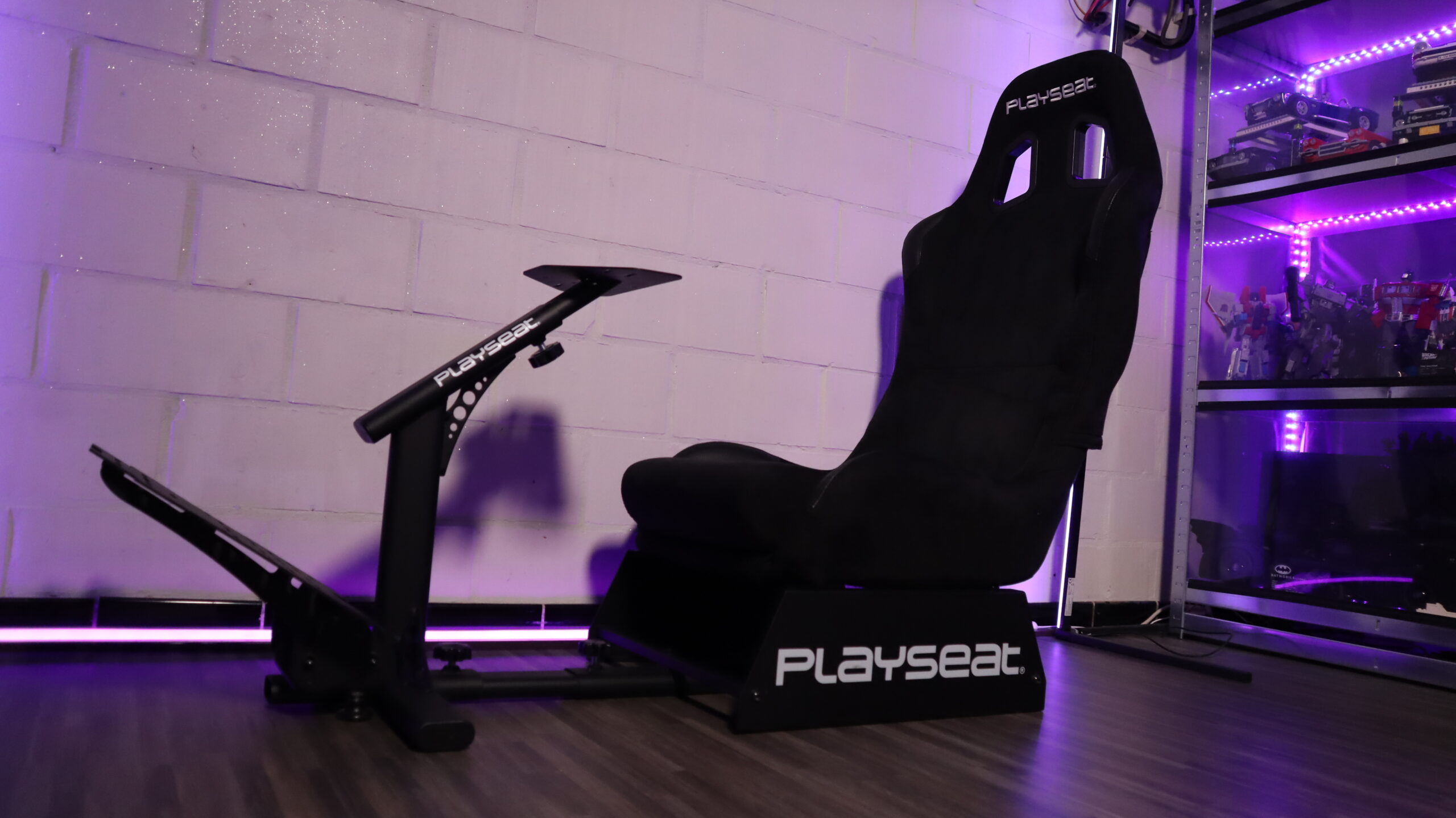
Playseat Evolution Review
The Icon That Introduced Thousands to Sim Racing
There are very few products in sim racing that can genuinely be called iconic. The Playseat Evolution is undoubtedly one of them. Originally introduced back in 2008, it quickly became the cockpit that introduced thousands of enthusiasts to the hobby. For many years, owning a Playseat Evolution almost became synonymous with owning a sim racing cockpit.
Nearly two decades later, however, the sim racing market has changed dramatically. Direct-drive wheelbases have become commonplace, pedal sets have become significantly more demanding, and today’s buyers have far more choice than they did when the Evolution first appeared.
Despite this, Playseat still sells the Evolution today with only relatively minor changes over the years.
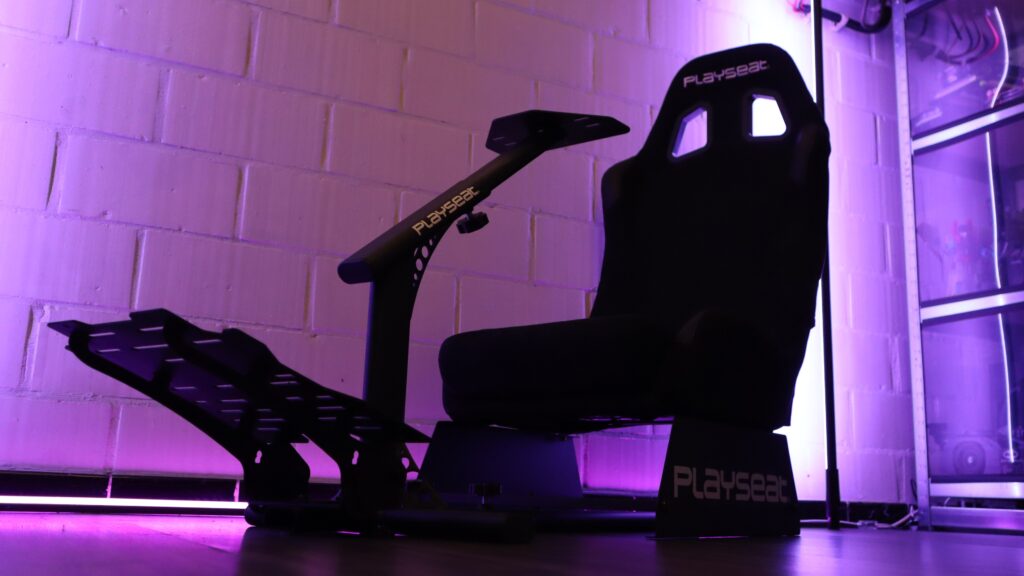
So the question is simple:
Does this legendary cockpit still deserve a place in today’s market?
📦 Packaging
The Playseat Evolution arrives with everything needed for assembly. Inside the box you’ll find an excellent assembly manual, all the necessary tools, mounting hardware for your wheelbase and pedals, and adhesive felt pads designed to prevent scratches on your floor.
The instructions are among the better manuals available in the sim racing market, making assembly straightforward even for first-time users.
🔧 Pedal Configuration
The pedal tray can be adjusted in two different ways.
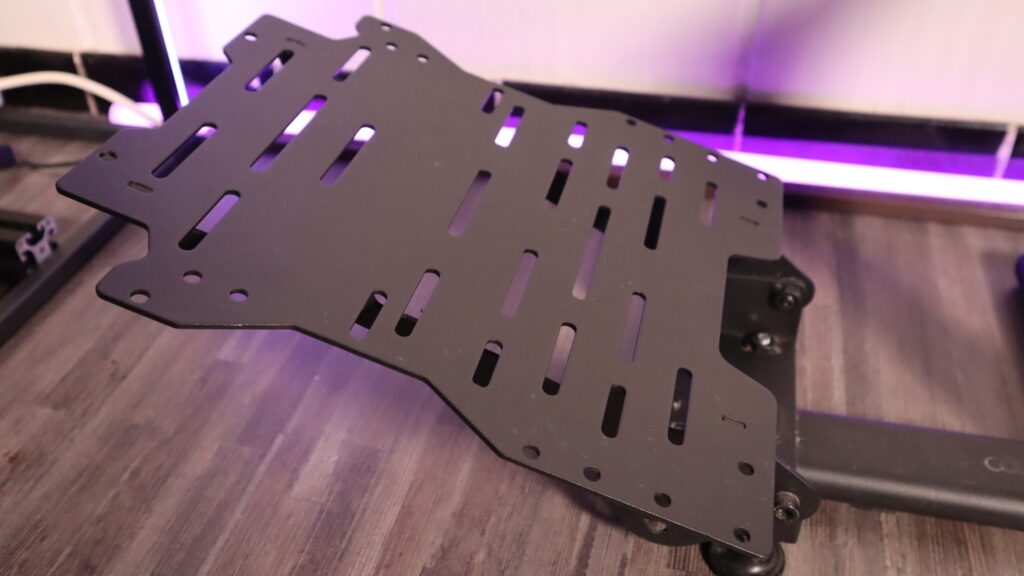
First, the pedal plate itself can be tilted from completely flat to a fairly steep angle. This works well for most consumer pedal sets. Pedals such as the MOZA SR-P Lite already feature a slight rearward angle in their own design, making the available adjustment perfectly adequate for entry-level and mid-range hardware.
More premium pedal sets, however, are often mounted vertically against the pedal plate. Since the Evolution’s pedal plate cannot tilt forward, compatibility with these designs becomes more limited. It isn’t necessarily a deal-breaker, but it does reduce flexibility compared to more modern cockpits.
The second adjustment concerns the distance between the pedals and the seat. This is one of the Evolution’s strongest features. Using a large hand knob, the complete pedal assembly can be moved forwards or backwards in just a few seconds without requiring any tools, providing ample adjustment for drivers of different heights.
One important observation, however, is that these adjustments rely purely on clamping force. There are no pre-drilled indexing holes or locking positions. Instead, the hand screw presses against the frame to keep everything in place. While this allows for quick adjustments, it doesn’t inspire the same confidence as more robust locking mechanisms.
🎮 Wheelbase Configuration
The wheelbase support offers two adjustments. The steering wheel can be raised or lowered using another hand screw, while the complete wheel support can also slide forwards and backwards.
Unfortunately, this is where the design begins to show its age.
The wheel mounting plate itself offers no angle adjustment, causing the steering wheel to sit relatively low. Furthermore, the adjustment range is closely linked to the pedal position. Moving the pedals closer also limits how far back the wheel support can travel, making it difficult to find a comfortable driving position.
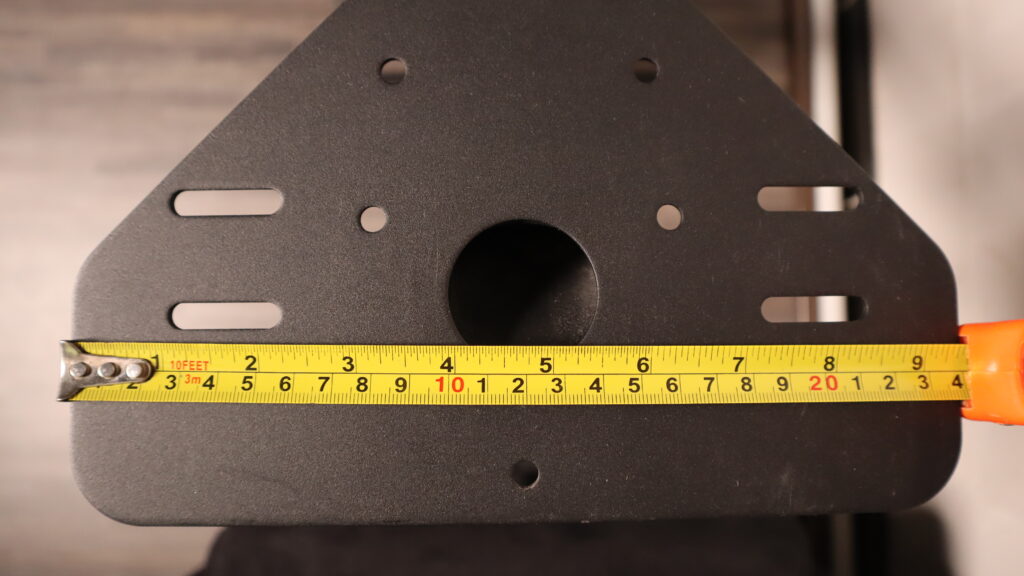
This is especially noticeable with modern direct-drive wheelbases that feature relatively flat mounting surfaces. Older Logitech wheelbases, which naturally angle the steering wheel upwards, actually suit the Evolution considerably better.
💺 Seat Configuration
Seat adjustment is fairly limited.
The seat itself slides forwards and backwards using the same quick-adjustment mechanism as the pedals, but beyond that there is very little to configure.
The backrest cannot recline, which is unfortunate considering the already low steering wheel position. Being able to lean the seat back slightly would greatly improve long-distance comfort and overall ergonomics.
Height accommodation has long been one of the most debated aspects of the Playseat Evolution. Rather than repeating that discussion, it’s sufficient to say that at 173 cm (5’8″), I struggled to find an ideal driving position using the available adjustments.
🔌 Compatibility
Playseat advertises compatibility with all major brands including Logitech, Thrustmaster, MOZA and Fanatec.
Technically this is true, but there are some important nuances.
The pedal plate contains numerous mounting slots, allowing most consumer pedal sets to be installed without major issues. The wheel mounting plate, however, offers fewer mounting possibilities. During testing, my MOZA R5 could only be secured using two mounting bolts rather than the four that most modern cockpits allow.
While the cockpit is compatible with many products, compatibility isn’t always optimal.
📈 Pedal Rigidity
For testing, I mounted the MOZA SR-P Lite pedals.
Even with these relatively light pedals, noticeable vertical flex is present under braking. This movement originates from the lack of rear support underneath the pedal tray.
The issue isn’t simply that the movement is visible; it is also clearly noticeable while driving.
For casual driving this may not be a major concern. However, drivers looking to improve consistency or set competitive lap times will quickly find the flex frustrating.
Using load-cell pedals only amplifies the problem. Since those pedals rely on consistent pressure rather than travel, the flex in the pedal tray prevents drivers from fully benefiting from the hardware.
💪 Wheelbase Rigidity
The wheel support performs even less convincingly.
Its single central support combined with the clamping adjustment mechanism makes the assembly particularly vulnerable to movement.
Side-to-side rigidity remains acceptable, but front-to-back movement is significant.
Even the relatively modest MOZA R5 proved capable of generating enough force to produce considerable flex.
It’s important to place this into historical context. When the Playseat Evolution was originally designed, direct-drive wheelbases were still niche products. Logitech’s G25 and G27 represented the high-end consumer market at the time.
Unfortunately, the Evolution has never truly evolved alongside modern hardware.
Although members of the sim racing community have developed reinforcement modifications capable of supporting direct-drive wheelbases, those upgrades require additional time, effort and expense. Out of the box, this is not a cockpit I’d recommend pairing with modern direct-drive hardware.
🛋️ Seating Comfort
Comfort is a mixed experience.
Initially, the seat feels supportive and remains comfortable during sessions of around two hours. The lower cushion offers sufficient support without creating pressure points.
The lack of adjustability, however, becomes increasingly noticeable over longer sessions. Additional lumbar support and a reclining backrest would significantly improve overall comfort.
The seat also produces noticeable squeaking during use, something that some users may find distracting.
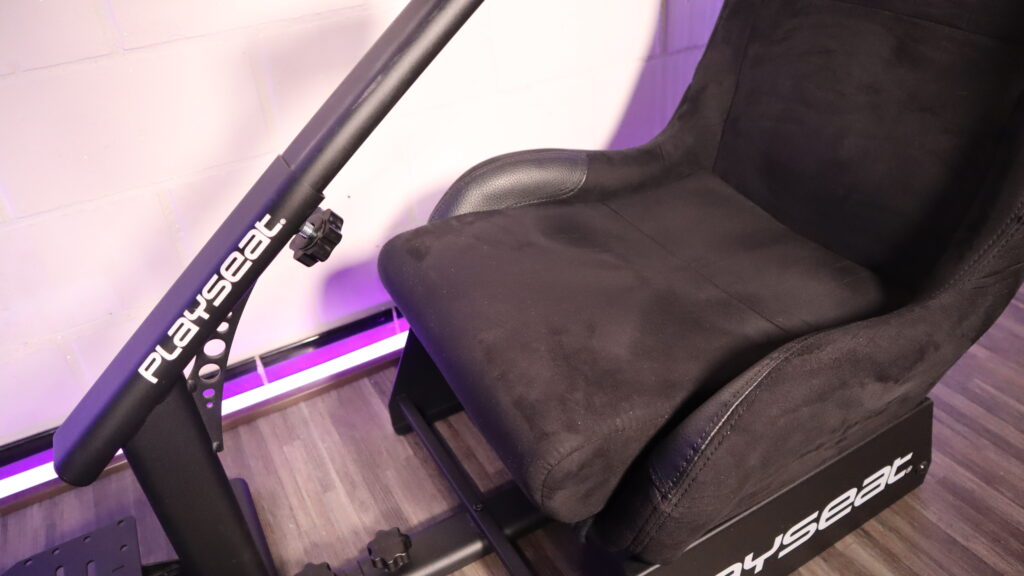
Finally, because the backrest folds down for storage, it doesn’t feel quite as rigid as a permanently fixed seat.
🚧 The Centre Support Pole
Perhaps the Playseat Evolution’s most famous design feature is also its biggest weakness.
With a two-pedal setup, the centre support pole causes little inconvenience. Both accelerator and brake remain easy to operate.
The situation changes considerably once a clutch pedal is added.
The brake pedal ends up positioned directly behind the centre support, forcing the driver’s foot into an awkward angle during braking. This quickly becomes uncomfortable and makes heel-and-toe driving particularly difficult.
For this reason, I would not recommend the Evolution for users planning to drive with a traditional three-pedal setup.
📐 Footprint & Storage
If there is one category where the Playseat Evolution still excels, it is space efficiency.
When unfolded, it measures approximately 130 × 48 × 98 cm, making it remarkably narrow compared to most rigid sim racing cockpits.
Folded for storage, the dimensions shrink to roughly 108 × 60 × 48 cm, allowing the cockpit to fit into surprisingly compact spaces.
Combined with its relatively modest weight of 21 kg, the Evolution remains easy to move around and store whenever necessary.
💰 Price
Pricing varies depending on the retailer and the chosen version.
The Racing Suede Edition reviewed here retails for approximately €279 through Playseat’s official store, while retailers frequently offer discounts bringing the price closer to €250–260.
Other variants include the breathable ActiFit Edition, which I personally prefer due to improved ventilation, and the Pro Edition, which mainly adds extra head bolstering while leaving the underlying cockpit unchanged.
Although the new retail price feels relatively high considering the cockpit’s age, the second-hand market tells a different story.
Because Playseat has sold enormous numbers of Evolution cockpits over the years, used examples are widely available for around €120–150, representing significantly better value.
🏁 Final Verdict
Reviewing the Playseat Evolution in 2026 is a fascinating experience.
Fifteen years ago, it helped define what a home sim racing cockpit looked like. Today, however, the market has advanced considerably while the Evolution itself has remained largely unchanged.
Its rigidity no longer meets the demands of modern direct-drive hardware. Seat adjustment is limited, compatibility with some newer equipment is less than ideal, and the centre support pole remains a fundamental compromise.
Its biggest strengths continue to be its compact footprint, quick adjustment mechanisms and the enormous availability on the second-hand market.
At its current retail price, I find it difficult to recommend over more modern alternatives.
At around €120–150 on the used market, however, the equation changes completely. For newcomers—or parents looking for an affordable first cockpit for their children—it still offers an enjoyable and authentic introduction to sim racing.
Taking everything into account, the Playseat Evolution earns a C-tier in the Sim Tourist Scorecard.
It may no longer lead the pack, but its place in sim racing history is unquestionable.
👍 Pros
- Excellent footprint
- Quick pedal adjustment
- Easy assembly
- Huge second-hand availability
- Still a good entry point at used prices
👎 Cons
- Very poor wheelbase rigidity
- Pedal tray flex
- Limited seat adjustment
- Centre support pole
- Expensive when bought new
Extra resources:
No posts


