Oplite Nitrokart V2 Review
A compact, lightweight and surprisingly capable cockpit with one very specific goal: bringing the feeling of a kart into your home.
Four years after reviewing the original Oplite Nitrokart, Oplite asked me to take a look at its successor: the Nitrokart V2.
At first glance, not much seems to have changed. The basic concept remains the same: a small tubular cockpit with a low seating position, a kart-style bucket seat and plenty of adjustment options.
But the V2 does bring some important changes, particularly around the seat and the overall finish.
And then there is the price.
At around €230, the Nitrokart V2 sits considerably below the price of many conventional tubular cockpits. That immediately makes it an interesting proposition for anyone looking for a dedicated driving setup without spending a fortune or giving up half of their room.
So let’s take a closer look.
💶 Price & What’s Included
At approximately €230, the Nitrokart V2 occupies an interesting position in the cockpit market. Conventional tubular cockpits often cost €400–€500 for the frame and seat alone, making Oplite’s offering considerably more accessible.
And the price includes quite a comprehensive package. You get the frame, karting seat, mounting hardware for the wheelbase and pedals, cable clips, rubber feet, bolt covers, an assembly manual and even the tools required for assembly.
Putting everything together is relatively straightforward. The instructions are clear, the components fit together without any particular difficulty, and I didn’t encounter any alignment issues during assembly. The whole process took me less than two hours.
For a cockpit at this price, getting a complete package without having to purchase essential components separately is a welcome advantage.
🏗️ Design and Build Quality
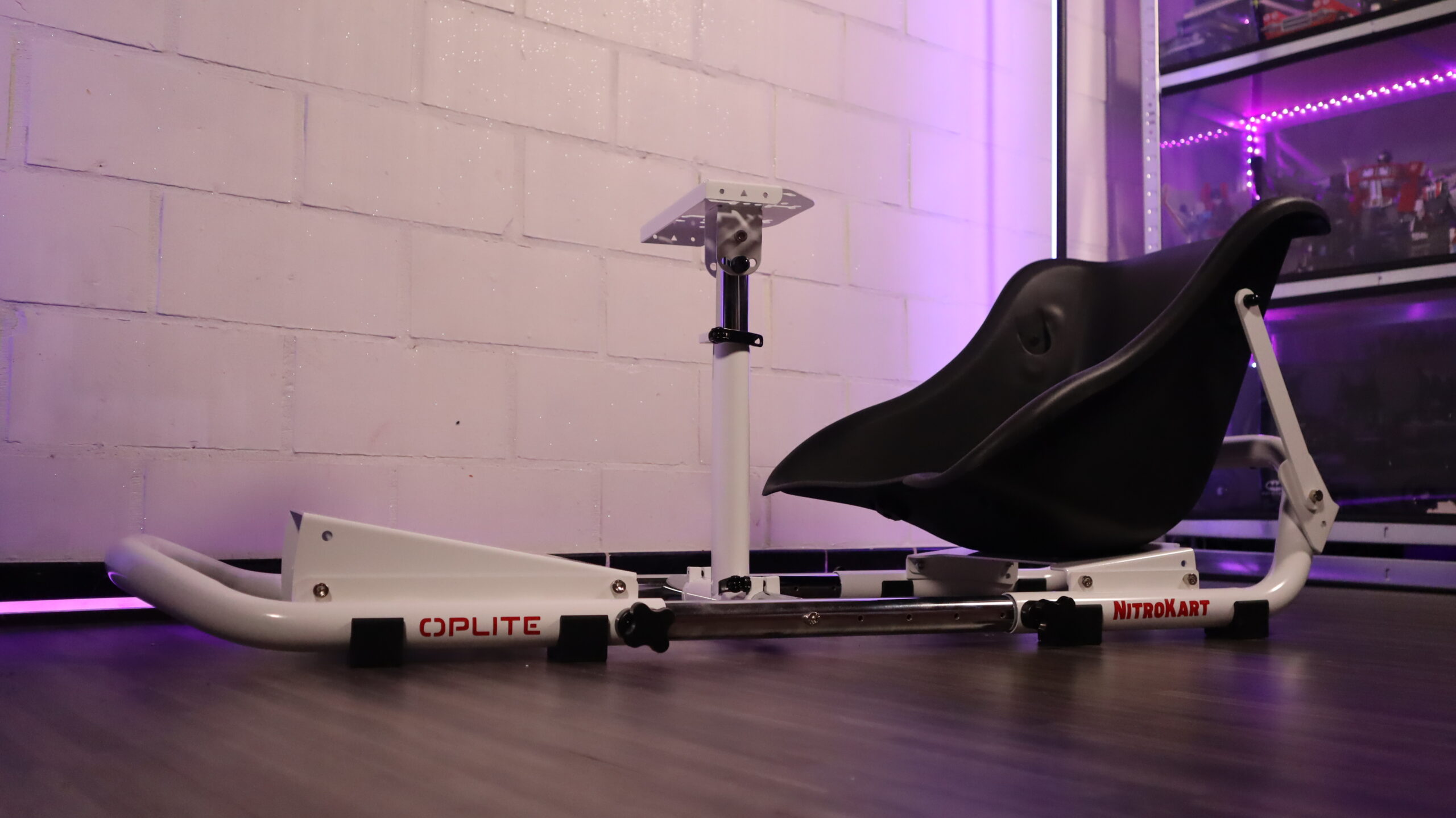
The Nitrokart V2 is built around a tubular steel frame with a distinctive white finish and red Oplite and Nitrokart branding. Its design is clearly inspired by karting, with a very low seating position and a compact layout.
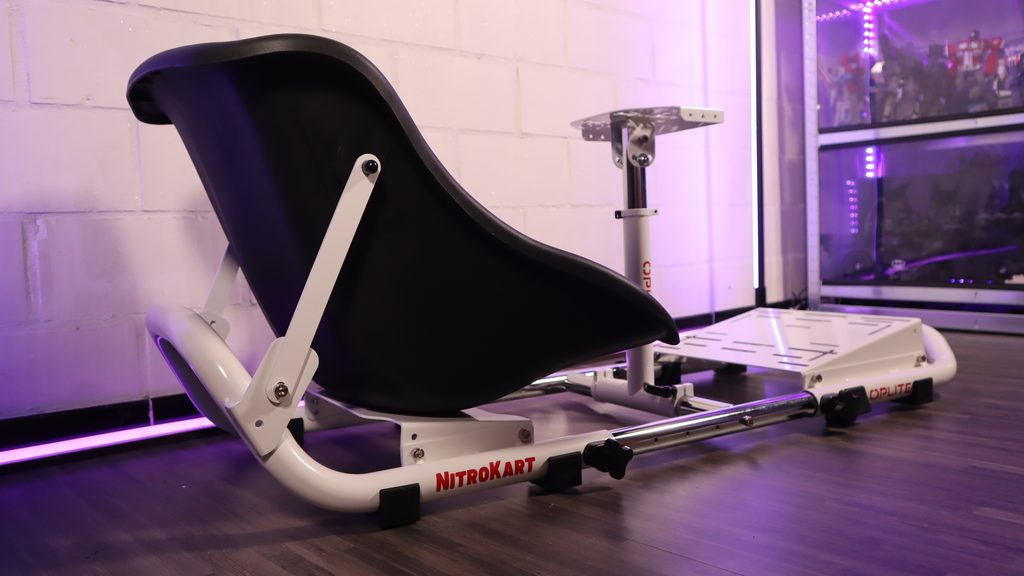
While budget cockpits sometimes sacrifice appearance in favour of functionality, I think Oplite has managed to avoid that trap. The thick, shiny white paint looks good and seems reasonably resistant to scratches. The red accents, cable clips, bolt covers and chunky rubber feet all contribute to a surprisingly polished appearance.
The seat has also received some attention. Unlike the original, the V2 uses a hard-plastic bucket with additional steel reinforcement at the rear. This makes it easier to get in and out of the seat and gives it a more substantial feel.
The overall construction is relatively simple, but that’s part of its appeal. It doesn’t try to imitate a large aluminium profile cockpit. Instead, it sticks to a compact design that suits its intended purpose.
🧱 Rigidity and Stability
Rigidity is one of the most important aspects of any cockpit, and the Nitrokart V2 has some clear strengths as well as limitations.
The main frame feels sufficiently solid for the type of driving this cockpit is designed for. However, some movement becomes apparent when considerable force is applied, particularly around the pedal mounting area and the wheelbase support.
Pedal mounting rigidity
The pedal plate itself is reasonably thick, and the mounting brackets hold up well under pressure. With Logitech G pedals, I noticed some movement in the middle of the frame when applying force to the pedals. The same behaviour was present with my SimLab XP1 pedals, even though the plate and mounting brackets remained firmly in place.
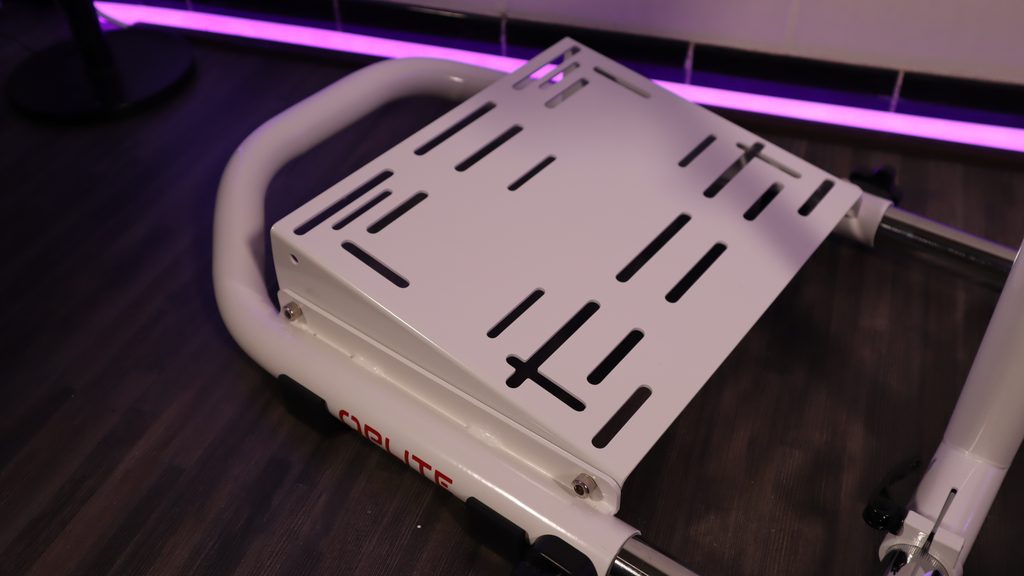
It’s therefore not so much the pedal plate itself that is the limiting factor, but rather the movement in the frame supporting it.
For ordinary driving, I don’t think this is likely to bother most users. Nevertheless, drivers who apply particularly heavy braking pressure may notice it.
Wheelbase rigidity
The wheelbase holder is where the limitations become much more apparent.
Oplite has retained the single-pole design of the original Nitrokart. With my Logitech RS50 at 8 Nm, there’s some side-to-side movement and considerably more front-to-back movement. While it is noticeable, I didn’t find it particularly distracting while driving.
Things change considerably when moving to an 18 Nm Fanatec. The wheelbase holder starts wobbling quite substantially in both directions, making the movement difficult to ignore.
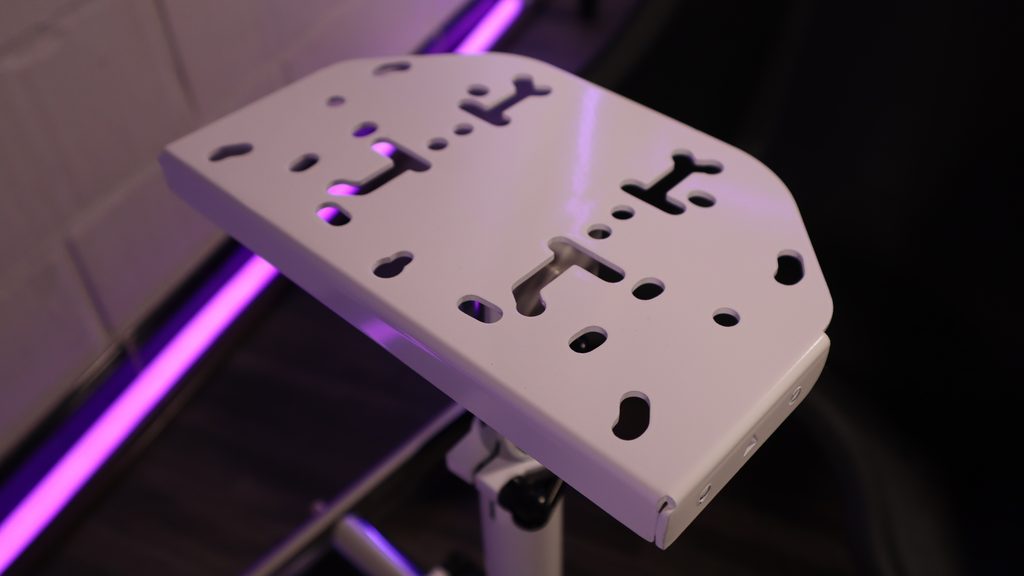
Oplite doesn’t specify an official torque limit, but based on my testing, I’d consider approximately 8 Nm a sensible upper limit. Beyond that, the movement becomes too pronounced for my liking.
This is an important distinction. The frame itself is perfectly usable for its intended purpose, but the single-pole wheelbase support puts a fairly clear limit on how much torque I’d recommend using.
Stability on the floor
One aspect I particularly appreciate is the use of eight substantial rubber feet. They help keep the cockpit firmly planted and do a good job of preventing vibrations from being transferred to the floor.
During normal driving, I experienced very little rattling or creaking. That’s a definite advantage if you share your home with other people or simply prefer a quieter setup.
Overall, the Nitrokart V2 offers sufficient rigidity for moderate wheelbase torque and ordinary pedal use, but it isn’t designed for the forces generated by high-torque hardware.
⚙️ Configuration and Adjustability
One of the Nitrokart V2’s most interesting characteristics is the number of adjustment options available. Despite its relatively simple construction, there’s quite a bit you can change to accommodate different drivers and driving preferences.
🕹️ Wheelbase adjustment
The wheelbase holder offers a considerable amount of flexibility. Its height can be adjusted from approximately 39 to 60 cm, while the entire support can be pivoted towards or away from the driver.
The wheelbase plate itself also has three inclination positions, allowing you to fine-tune the steering wheel’s angle.
Several of these adjustments can be made relatively quickly using the clamps, which is particularly useful if more than one person uses the cockpit.
🦶 Pedal adjustment
The pedal plate offers three positive inclination positions, up to approximately 30 degrees. By reversing the plate, you also get three negative positions, as well as a flat configuration.
Pedal distance is adjusted by sliding the front section of the frame along its two supporting tubes. Two hand screws make this adjustment relatively quick, while changing the pedal inclination requires tools.
There’s also a good degree of flexibility in terms of pedal compatibility. Oplite lists support for Fanatec, MOZA, Thrustmaster, Logitech and Hori, and I had no problems mounting my SimLab XP1 pedals using all four attachment points.
🪑 Seat adjustment
The seat has three inclination positions, ranging from 0 to 14 degrees. Its distance from the wheelbase can also be adjusted by sliding the rear section of the cockpit along the frame.
Combined with the wheelbase and pedal adjustments, this allows drivers to find a position that suits their individual preferences.
Oplite states that the cockpit is suitable for children from approximately 115 cm tall through to adults. The range of adjustment certainly makes that a plausible proposition, and it’s one of the reasons the Nitrokart V2 can work particularly well as a family cockpit.
The important thing to remember, however, is that extensive adjustability doesn’t automatically mean maximum rigidity. The Nitrokart offers plenty of flexibility, but the trade-off is particularly noticeable around the wheelbase holder.
🪑 Seat and Comfort
The seat is arguably the most significant improvement over the original Nitrokart.
The V2 uses a durable hard-plastic bucket seat with additional steel reinforcement at the rear. Besides making the seat feel more substantial, the reinforcement makes it easier to get in and out without having to worry too much about putting pressure on the sides.
And I have to say, it looks the part.
The shape and low seating position give you a very convincing karting experience. The seat is snug, offers good lower-back support and puts you in a position that feels quite different from sitting in a conventional GT cockpit.
In fact, it almost feels like being three years old and sitting on a potty. Which, if you’ve ever driven a real kart, is perhaps not such an inaccurate comparison.
Comfort is a slightly different story, though. The seat provides good support, but the lack of padding underneath can become an issue during longer sessions. After an hour or two, you may find yourself wishing for a little more cushioning.
That’s not necessarily a deal-breaker. The Nitrokart is designed to replicate the feeling of sitting in a kart, rather than provide the comfort of a touring car seat. Nevertheless, it’s something worth considering if you regularly spend several hours behind the wheel.
For smaller drivers, Oplite also offers a separate reducer cushion, which helps them sit more snugly in the bucket.
🦵 The Centre Pole
Centre poles have never been my favourite design feature in a cockpit. I encountered similar problems with the Playseat Evolution, where the pole sometimes forced me to position my foot awkwardly when using a three-pedal setup.
Oplite has done a reasonable job of minimising the problem on the Nitrokart V2. The pole sits relatively close to the driver and is almost vertical, making it considerably less intrusive than some alternative designs.
However, it hasn’t eliminated the problem entirely. When using a three-pedal setup, the pole can still get in the way slightly, particularly when braking.
With a two-pedal setup, the situation is considerably better, as the pedals can be positioned further apart.
It’s not a major issue, but it’s something to bear in mind if you regularly drive cars with three pedals.
📐 Footprint and Portability
Compactness is one of the Nitrokart V2’s biggest selling points.
At approximately 52 cm wide and 140 cm long, it takes up considerably less space than many conventional cockpits. Its height is around 74 cm, depending on the configuration, and the complete setup weighs approximately 20 kg.
That relatively low weight makes a noticeable difference when you need to move it around.
The cockpit can also be folded down to approximately 120 cm long, with a depth of around 53 cm and a width of 52 cm. This makes it relatively easy to store when it’s not in use.
For anyone who doesn’t have a dedicated room for sim driving, that can be a significant advantage. You can bring the cockpit out when you want to drive and put it away afterwards without having to reorganise your entire living space.
It’s a practical benefit that can easily be overlooked when comparing cockpits purely on their technical specifications.
🖥️ Accessories and Expansion Options
Oplite offers several accessories that extend the functionality of the Nitrokart V2.
🖥️ Display stand
The separate display stand supports screens of up to 50 inches and offers a broad range of VESA mounting options. Its adjustable feet allow you to fine-tune the screen’s angle, while the rubber feet help keep it stable.
At approximately €100, it isn’t an insignificant additional expense. However, given how low the Nitrokart sits, having a dedicated display stand can be particularly useful.
A conventional desk or TV stand may leave your screen much too high for an immersive driving position.
🎮 Shifter and handbrake holder
For those who want a more complete setup, Oplite offers a combined shifter and handbrake holder for approximately €50.
The shifter holder attaches to the main frame, while the handbrake holder connects to the wheelbase support.
It’s a relatively inexpensive way to add more functionality without having to improvise your own mounting solution.
🧒 Seat reducer cushion
The seat reducer cushion is intended primarily for younger drivers. At approximately €80, it helps smaller users sit more securely in the bucket seat.
Considering that Oplite markets the Nitrokart as a cockpit for both children and adults, it’s a useful addition for families who want to share the same setup.
🏎️ Karting, GT or Something Else?
The Nitrokart V2 is clearly designed around karting, and that’s where its character really comes through. The low seating position, bucket seat and overall geometry create a driving experience that feels quite different from a conventional cockpit.
However, I wouldn’t limit it to karting.
With the right wheelbase and pedal configuration, I think it can work surprisingly well for GT driving, too. Its compact dimensions and adjustability make it a viable option for anyone who enjoys a more laid-back driving experience but doesn’t want to invest in a large, dedicated rig.
Of course, it isn’t going to replace a substantial aluminium profile cockpit for someone who needs maximum rigidity or regularly uses high-torque hardware. But that’s not really what the Nitrokart is trying to achieve.
Its appeal lies in its simplicity, affordability and distinctive seating position.
🏁 Final Verdict
The Oplite Nitrokart V2 is a worthwhile evolution of the original. The improved seat and overall finish are welcome changes, while the fundamental concept remains as appealing as ever.
Its biggest strengths are its compact footprint, low weight and extensive configuration options. The ability to accommodate a wide range of driver sizes also makes it an interesting option for families, particularly when the cockpit needs to be shared.
There are compromises, of course. The single-pole wheelbase holder limits the amount of torque you can sensibly use, the hard-plastic seat isn’t ideal for very long sessions, and the centre pole can still be intrusive when using three pedals. The low seating position can also require a different approach to screen placement.
Nevertheless, I was very positive about the original Nitrokart, and my opinion hasn’t changed much with the V2.
It’s a fun, compact and particularly affordable cockpit that manages to offer a distinctive driving experience without demanding a huge amount of space or money.
At around €230, it won’t suit everyone, but for those looking for a lightweight, karting-inspired cockpit, it has a lot to offer.
My final ranking: A-tier.
👍 Pros
- Very affordable complete package
- Compact footprint and low weight
- Easy to move and store
- Extensive configuration options
- Suitable for a wide range of driver sizes
- Distinctive karting-style seating position
- Good pedal mounting options
- Attractive finish and styling
- Effective rubber feet that reduce floor vibrations
- Surprisingly easy to get in and out of
👎 Cons
- Limited wheelbase rigidity, particularly with high-torque wheelbases
- Some movement in the middle of the pedal-supporting frame
- Hard-plastic seat can become uncomfortable during longer sessions
- Centre pole can interfere with three-pedal setups
- Low seating position may require a dedicated display stand
- Extensive adjustability comes with some rigidity compromises
Extra resources:
No posts


